
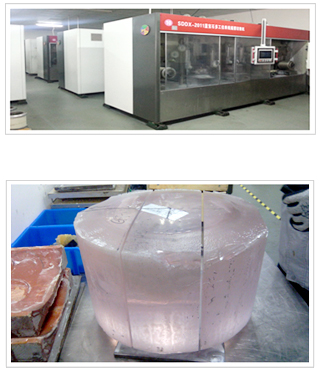
With a Mohs hardness of 9, second only to diamond, sapphire single crystals have long been cut using diamond grit-plated circular saw blades. For better surface finish, diamond grit-plated inner-diameter blades and band saws are also employed. Given the high cost of sapphire single crystals, even the thinnest circular saw blades are over 2 mm thick, leading to severe material waste—whereas the kerf of a diamond wire saw is a mere 0.2–0.4 mm.
Today, with the rapid development of electroplated and resin-bonded diamond wire saws, their quality has improved by leaps and bounds, and their market price has dropped to 20% of the original cost. Their cutting cost is now lower than that of the traditional slurry free-cutting method.
Single-wire saws imported from Europe and America have not performed satisfactorily in the domestic market, primarily due to the excessively small diameter of their wire take-up and pay-off reels. This causes the diamond wires to squeeze against each other during high-speed reciprocating motion, leading to diamond grit shedding and a decline in cutting performance. A large number of diamond grit particles fall off due to mutual extrusion before they can even perform their cutting function, meaning the actual cutting capacity never meets the manufacturers’ claimed specifications. This results in a substantial increase in wire consumption and persistently high cutting costs. Similarly, single-workstation cutting equipment requires repeated reciprocating motion to cut a single workpiece, with the number of reciprocations no less than that of multi-workstation equipment. For example: 100 meters of wire can cut exactly 1 workpiece, requiring 300 reciprocations; 300 meters of wire can cut 3 workpieces with only 100 reciprocations. This is because the total length of wire passing through the workpiece is constant for each cut—cutting a single workpiece requires 30,000 meters of wire travel in total. Using a 100-meter wire loop thus needs 300 reciprocations, while a 300-meter wire loop only needs 100 reciprocations for the same total travel.
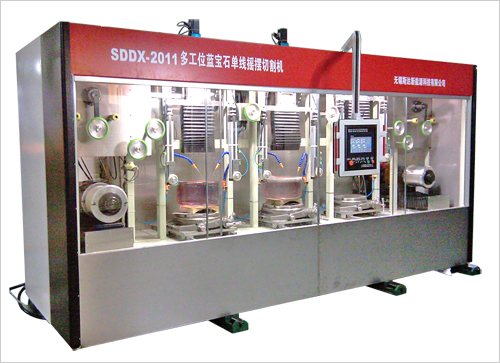
In summary, mutual extrusion of diamond wires during high-speed reciprocating motion causes diamond grit shedding and reduced cutting performance, with damage worsening as the number of cycles increases. Adopting a multi-workstation simultaneous cutting solution can effectively reduce wire consumption and significantly lower cutting costs. We have conducted on-site tests by integrating our cutting machine with a US-manufactured single-wire saw—retaining the latter’s workstations while using our wire take-up/pay-off, winding and tension control mechanism to drive 2 cutting workstations. After 30 days of continuous normal production, statistical data shows that diamond wire consumption was reduced by half compared to the original setup.
Our independently developed one-drive-multi sapphire diamond single-wire oscillating cutting machine has undergone on-site operation on nearly 20 units, achieving the expected wire-saving effect.
| Cutting workpiece specifications | max:400X400mm |
| Stations that can cut simultaneously | 3 (individually controllable) |
| Angle of rotating table | Resolution 0.01 degrees, digital display |
| Bearing of the rotating workbench | 200 kg |
| Workbench lifting stroke | max 450㎜ |
| Cutting speed during cutting | 0.01~99.9㎜/min adjustable |
| Rapid rise speed | 0.01~999 ㎜/min adjustable |
| Wire diameter | Outer diameter φ0.13~φ0.35㎜ |
| Spool storage | 30km / volume |
| Adjustable tension range | 5-50N |
| Line swing angle | 0~ ±7° adjustable |
| Wire-speed | 600m/min |
| Round trips (variable) | can be arbitrarily set |
| New line supply | can be arbitrarily set |
| Winding spool small diameter | φ285mm |
| Overall size | 4400 x 1550 x 2200 mm |
| Weight | 4500kg |
