
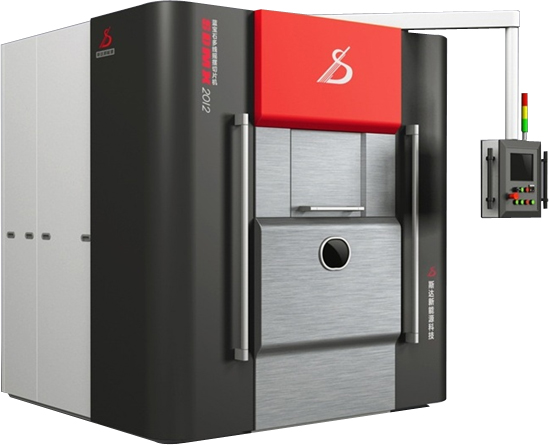
At present, diamond wire saws manufactured in Europe, America and Japan dominate most of the domestic market, yet their performance is far from optimal. The core issue lies in the excessively small diameter of the wire take-up and pay-off reels: this causes the wires to squeeze against each other during high-speed reciprocating motion, leading to the shedding of diamond particles and a decline in cutting efficiency. A large number of diamond particles fall off due to mutual extrusion before they can even perform their cutting function, meaning the actual cutting capacity never reaches the level claimed by diamond wire manufacturers. This results in a substantial increase in wire consumption for cutting and makes it impossible to further reduce cutting costs.
A typical Japanese oscillating wire saw adopts a design where the sapphire ingot to be cut remains stationary while the main cutting pulley oscillates. The main cutting pulley is fixed at a single end, which compromises its stability during high-speed operation and restricts the maximum wire speed to only 600 meters per minute—failing to fully unleash the performance of diamond wire. Additionally, its guide pulleys have a small diameter, which causes significant damage to the wire. That said, this model delivers excellent cutting quality, and several domestic manufacturers are basically producing replicas of it at present.
Another type of multi-wire saw features workpiece oscillation, with the sapphire ingot oscillating while the main cutting pulley stays fixed. This design allows the wire speed to reach 900 meters per minute, but the quality of the sliced wafers is inferior to that of the typical Japanese wire-net oscillating saws.
In summary, the mutual extrusion of diamond wires during high-speed reciprocating motion causes diamond particle shedding and reduced cutting efficiency, with the damage worsening as the number of cycles increases. Adopting large-diameter guide pulleys, reducing the number of guide pulleys, and increasing the diameter of the wire take-up and pay-off spools to minimize extrusion during winding can effectively lower wire consumption and cutting costs.
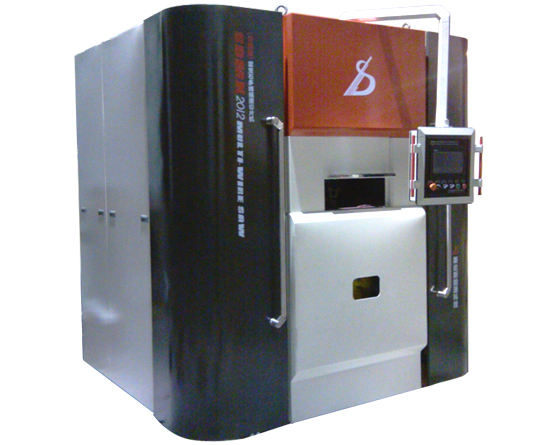
Our company has developed a wire-saving sapphire multi-wire oscillating slicer designed to overcome the aforementioned drawbacks. It features integrally cast guide pulleys fixed at both ends and a double cross ball bearing oscillation mechanism, which achieves an extremely high level of stability at high speeds. This design ultimately reduces the processing costs of sapphire single crystal cutting and improves processing efficiency.
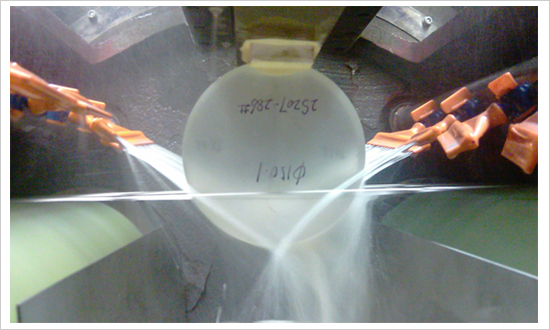
| Cutting workpiece specifications | φ160×300mm |
| Sheave | P.C.D 215±5×340×2 shaft |
| Distance between axes (horizontal) | 260mm |
| Small spacing of grooves | 0.3mm |
| Number of spindle revolutions | max 2000rpm |
| Workbench lifting stroke | max 400㎜ |
| Cutting speed during cutting | 0.01~100㎜/min adjustable |
| Rapid rise speed | 0.01~300㎜/min adjustable |
| Wire diameter | Outer diameter φ0.13~φ0.35㎜ |
| Spool storage | 30km / volume |
| Adjustable tension range | 5-50N |
| Line swing angle | 0~ ±7° |
| Linear rolling speed | 1~999°/min |
| Wire-speed | 1200m/min |
| Mean linear velocity | 900m/min |
| Round trips (variable) | Can be arbitrarily set |
| New line supply | Can be arbitrarily set |
| Winding spool small diameter | φ285mm |
| Number of wire guides | Total of 8 (reduced design) |
